
The Most Dangerous Thing About AI Is Not AI
Artificial intelligence itself may not be the greatest danger humanity faces. The deeper danger may lie in how human beings choose to use it — and what they slowly abandon in the process.
Discussions about artificial intelligence often focus on the technology itself.
Will machines become too intelligent? Will automation replace human work? Will AI eventually surpass human creativity?
These are important questions.
But they may not be the deepest ones.
Technology reflects human intention
Technology is rarely neutral in its effects, but it is still shaped by human choices.
Artificial intelligence can assist medicine, science, creativity and communication in extraordinary ways.
It can remove barriers. Expand imagination. Accelerate discovery.
But the same systems can also amplify distraction, manipulation, emotional emptiness and passive dependence if used without wisdom.
The danger of losing human depth
One of the greatest risks is not that machines become too human.
It is that humans slowly become more machine-like themselves.
Constant optimisation. Endless productivity. Permanent distraction. Reduced attention spans. Emotional detachment.
When speed, efficiency and stimulation dominate everything, deeper human qualities can slowly erode.
Reflection. Patience. Imagination. Emotional presence.
It is emotionally disconnected humanity.
The illusion of infinite stimulation
Modern digital systems already shape human behaviour profoundly.
Algorithms constantly compete for attention. Platforms reward reaction more than reflection. Endless stimulation leaves little space for silence or emotional depth.
Artificial intelligence may intensify this even further by making distraction infinitely scalable.
Yet human beings are not designed to live entirely inside endless acceleration.
Why imagination and atmosphere matter
This is precisely why atmosphere, imagination and emotional creativity become increasingly important.
They reconnect people with slower forms of perception. With reflection. With wonder. With emotional meaning beyond pure efficiency.
Art reminds humanity that existence is more than optimisation.
It reminds people how to feel.
Futureworld Orchestra and the emotional signal
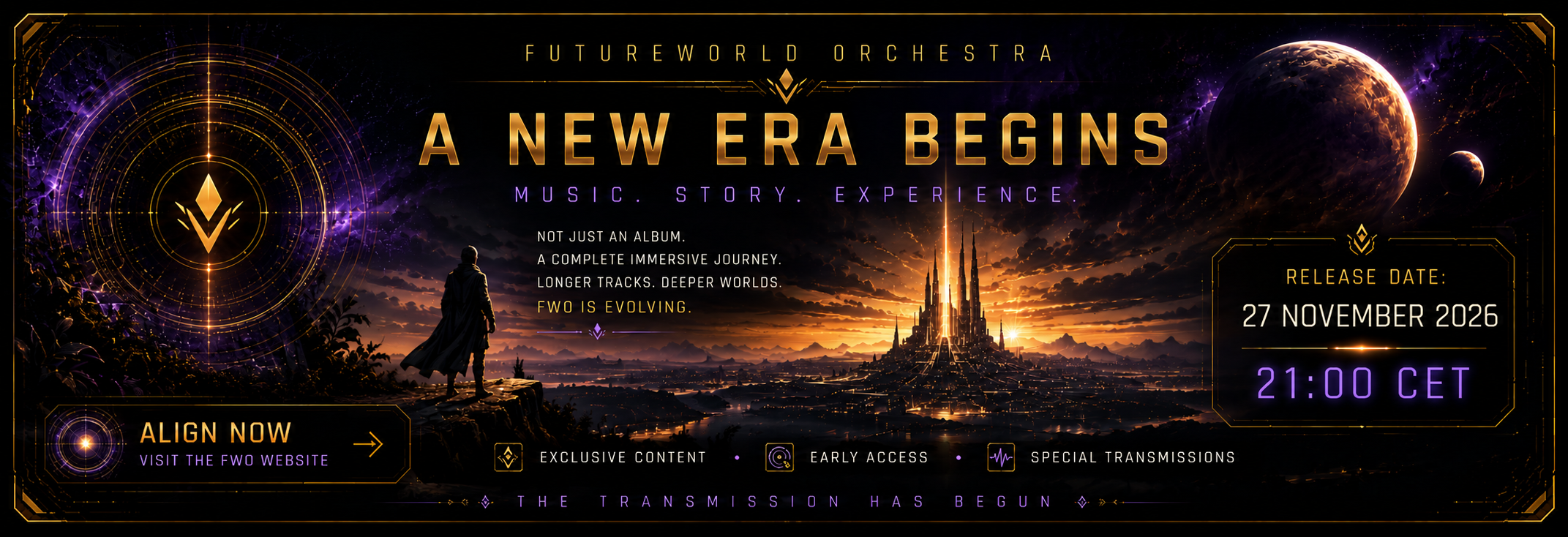
Much of the atmosphere surrounding Futureworld Orchestra reflects this tension between technological civilisation and emotional humanity.
Cosmic systems. Signals. Alignment. Intergalactic transmissions. Futuristic environments filled with mystery and longing.
Beneath the science-fiction aesthetics lies a deeper emotional question:
Can humanity remain emotionally connected inside an increasingly artificial world?
The project is not anti-technology.
It is pro-humanity.
The future depends on human choices
Artificial intelligence will continue evolving rapidly.
That evolution itself is probably unstoppable.
But technology alone does not determine civilisation.
Human values still matter. Emotional wisdom still matters. Imagination still matters.
The future may ultimately depend less on how intelligent machines become — and more on whether human beings remain emotionally awake while using them.
It is forgetting what makes humanity worth preserving in the first place.
Stay connected with Futureworld Orchestra and receive future transmissions, previews and special updates.
Align with FWO