
AI Should Amplify Artists — Not Replace Them
Artificial intelligence has the power to expand human creativity in extraordinary ways. But technology should strengthen artistic vision — not erase the human spirit behind it.
We are entering a period where artists suddenly have access to tools once unimaginable.
Entire cinematic worlds can emerge from imagination faster than ever before. Music production workflows can accelerate dramatically. Visual concepts that once required massive budgets can now be explored from a small studio.
In many ways, this is an extraordinary moment for creativity.
But with that power comes an important question:
The real value of an artist
The true value of an artist has never been the ability to simply produce material.
Machines may eventually generate endless songs, endless images and endless streams of content.
But art is not merely output.
Art reflects perspective. Emotion. Memory. Personality. Human vulnerability.
The greatest works often resonate because they carry traces of the life behind them.
That human connection cannot simply be automated away.
Technology should remove barriers
Used correctly, AI can remove technical limitations that once prevented artists from fully expressing their imagination.
A single creator can now visualise cinematic concepts, experiment with worlds, explore new musical directions and communicate ideas globally in ways previously reserved for major studios.
That is not the death of creativity.
In many ways, it may become one of the greatest expansions of creative freedom in modern history.
It becomes powerful when it amplifies it.
The danger of creative emptiness
The real risk is not AI itself.
The real risk is what happens when people stop creating from genuine emotion and begin creating only to feed systems, algorithms and endless content cycles.
Technology without artistic identity quickly becomes empty.
Audiences may initially be impressed by technical perfection, but people ultimately search for something deeper:
Atmosphere. Humanity. Meaning. Emotional truth.
How I use AI inside Futureworld Orchestra
Within Futureworld Orchestra, I use AI to expand creative possibilities — not to replace the artistic core itself.
AI helps visualise worlds. It accelerates experimentation. It helps shape immersive experiences around the music.
But the emotional direction remains entirely human.
The fascination with science fiction. The memories behind the music. The emotional atmosphere. The sense of wonder.
Those things still originate from human imagination.
The future may belong to hybrid creators
The artists who thrive in the future may not be those who reject technology completely.
Nor will they necessarily be those who surrender entirely to automation.
The future may belong to creators who understand how to combine advanced tools with authentic artistic identity.
People who still create from emotion. From vision. From curiosity. From humanity.
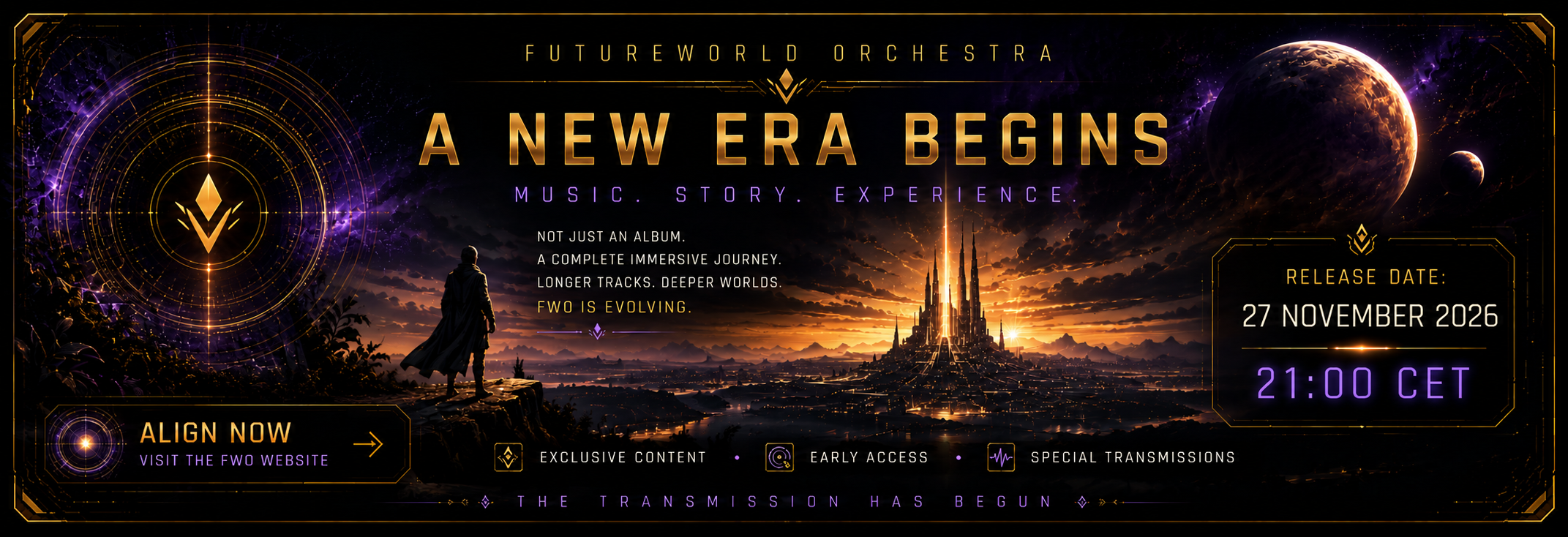
Stay connected with Futureworld Orchestra and receive future transmissions, previews and special updates.
Align with FWO