
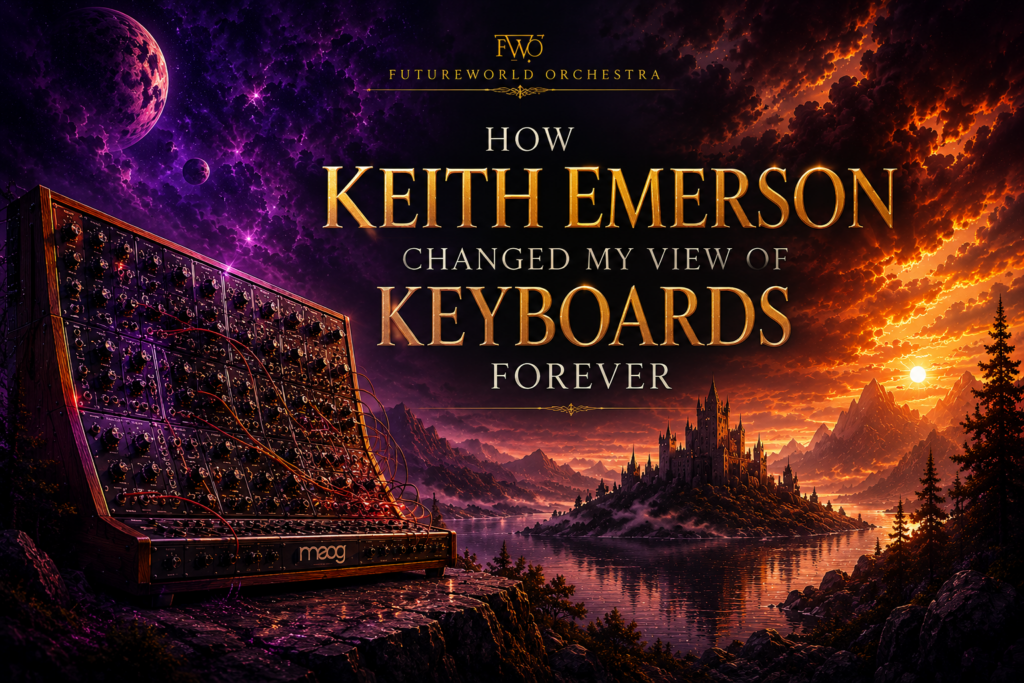
How Keith Emerson Changed My View of Keyboards Forever
Some musicians teach you how to play an instrument. Others completely redefine what that instrument can become. Keith Emerson did exactly that.
Every musician remembers certain moments that permanently alter the way they think about music.
For me, discovering Keith Emerson was one of those moments.
Before hearing Emerson, I viewed keyboards primarily as instruments for harmony, accompaniment and melody.
Important instruments, certainly.
But still instruments operating within fairly familiar boundaries.
Keith Emerson shattered those boundaries completely.
A Force Of Nature Behind The Keyboard
The first thing that struck me about Emerson was the sheer energy he brought to the instrument.
He wasn't simply playing keyboards.
He seemed to be attacking possibilities.
Every performance felt alive.
Unpredictable.
Fearless.
There was an excitement in his music that suggested anything could happen next.
As a listener, that was exhilarating.
As a keyboard player, it was eye-opening.
He expanded its universe.
Discovering Tarkus
One of the albums that had a profound impact on me was Tarkus.
Even today it remains one of the boldest statements in progressive rock.
The music felt enormous.
Ambitious.
Completely unconcerned with convention.
Listening to it for the first time was like discovering a new continent.
The Hammond organ roared.
The synthesizers screamed and sang.
The compositions unfolded with a confidence that was impossible to ignore.
It showed me that keyboards could stand at the centre of a musical world rather than simply support it.
The Moog Pioneer
Looking back now, it is difficult to appreciate just how revolutionary Emerson's work with the Moog synthesizer really was.
Today we have access to countless virtual instruments and software recreations.
Entire studios can exist inside a computer.
But in those days the synthesizer represented unexplored territory.
Emerson approached that territory with curiosity and courage.
He wasn't afraid of technology.
He embraced it.
More importantly, he transformed technology into art.
Virtuosity Was Never The Point
Of course, Keith Emerson possessed extraordinary technical ability.
That much is obvious.
Yet what continues to inspire me is not simply the virtuosity.
It is the imagination behind it.
Every run, every chord, every unexpected turn seemed to serve a larger creative vision.
The music never felt like an exercise.
It felt like an adventure.
That distinction is important.
Technical skill may impress.
Imagination inspires.
A Lasting Influence On My Own Musical Thinking
Looking back over the decades, I can clearly see the influence Keith Emerson had on my own perception of keyboards.
Not because I wanted to imitate him.
Nobody could be Keith Emerson except Keith Emerson.
Instead, he expanded my understanding of what was possible.
He taught me that keyboards could create entire worlds.
They could be cinematic.
They could be orchestral.
They could be powerful enough to carry an entire musical vision.
That lesson has remained with me throughout my journey with Futureworld Orchestra.
Why He Still Matters Today
We live in an era of extraordinary technology.
Musicians have access to tools Keith Emerson could only have dreamed of.
Yet his work remains relevant because the true lesson was never about equipment.
It was about imagination.
Curiosity.
Experimentation.
The willingness to push beyond what already exists.
More than anything else, that is what Keith Emerson taught me.
And it continues to inspire me every time I sit behind a keyboard.
Great musicians master their instruments.
Visionaries redefine them.
Stay connected with Futureworld Orchestra and receive future transmissions, previews and special updates.
Align with FWO