
The Difference Between Noise and Signal
In a world saturated with information, visibility and endless stimulation, the rarest thing may no longer be content itself — but meaning strong enough to cut through the noise.
Modern civilisation has become extraordinarily loud.
Endless updates. Endless notifications. Endless streams of information competing constantly for attention.
Every platform demands visibility. Every algorithm rewards activity. Every moment becomes crowded with signals fighting to be seen.
Yet paradoxically, the more information exists, the harder genuine meaning becomes to recognise.
Signal creates emotional clarity.
Noise is designed to keep moving
Noise rarely asks people to pause, reflect or emotionally connect.
Its purpose is constant stimulation.
Endless movement. Endless distraction. Endless reaction.
Noise fills time quickly but often leaves little emotional residue afterwards.
It disappears almost as rapidly as it arrives.
Signal carries meaning
A true signal feels different.
It cuts through distraction because it carries emotional or symbolic weight.
Something human. Something intentional. Something capable of creating resonance beyond immediate consumption.
Signal often feels quieter than noise — yet far more powerful.
Because people remember what emotionally resonates with them.
It is meaning capable of surviving distraction.
Why the difference matters now
Artificial intelligence and digital systems are rapidly increasing the amount of available content in the world.
Images. Music. Text. Video. Endless synthetic output generated at enormous scale.
As abundance increases, emotional significance becomes more valuable.
The challenge of the future may no longer be gaining access to information.
The challenge may become recognising what actually matters.
Atmosphere as signal
Atmosphere often functions as a form of emotional signal.
Certain sounds, images or artistic experiences immediately create emotional coherence amid surrounding fragmentation.
They slow perception down. They create emotional focus. They invite deeper reflection rather than instant reaction.
This is why atmosphere often leaves such a lasting memory.
Futureworld Orchestra and the idea of signal
The entire language surrounding Futureworld Orchestra increasingly revolves around this idea of signal.
Transmissions. Alignment. Emotional broadcasts. Hidden systems. Cosmic communication across distance and isolation.
These concepts symbolically reflect a deeper modern reality:
Human beings searching for meaning within overwhelming digital noise.
The music and surrounding worlds aim not merely to add more noise, but to create emotional resonance strong enough to feel like a signal reaching through the static.
The future may belong to signal creators
As technology accelerates and information expands endlessly, truly meaningful artistic experiences may become increasingly valuable.
Not because they shout the loudest.
But because they create emotional coherence in a fragmented world.
People may increasingly search for creators capable of producing not merely stimulation — but signal.
Signal continues echoing through memory, imagination and emotion.
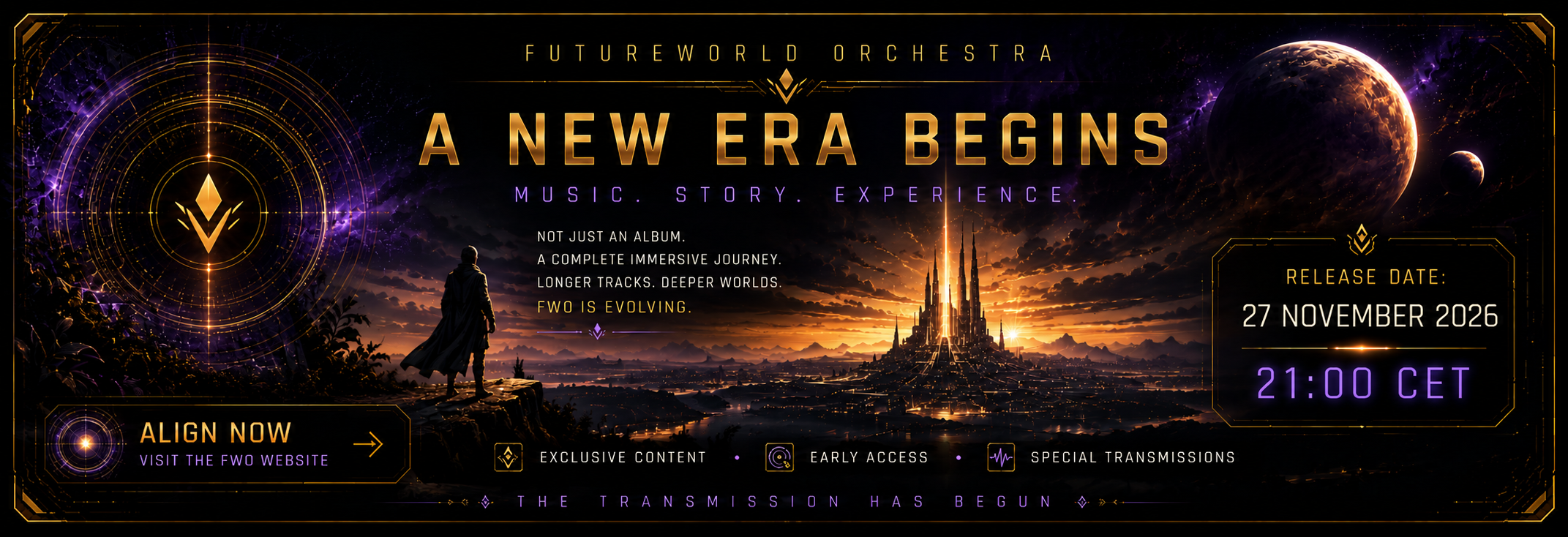
Stay connected with Futureworld Orchestra and receive future transmissions, previews and special updates.
Align with FWO