
The Emotional Role of Music in an AI World
As artificial intelligence transforms creativity, music may become even more important as a deeply human emotional language connecting memory, identity and feeling.
Music has always been more than entertainment.
Long before modern technology existed, music already carried emotion across generations. It connected people through ritual, memory, imagination and shared human experience.
Even today, a single melody can instantly reopen emotions buried for decades.
Music does something language alone often cannot fully explain.
The growing presence of AI
Artificial intelligence is now rapidly entering the musical landscape.
Songs can be generated within seconds. Voices can be replicated. Entire arrangements can emerge almost instantly from prompts and algorithms.
Technically, this evolution is astonishing.
But it also raises deeper questions about the emotional future of music itself.
Why people emotionally connect to music
Human beings rarely connect to music purely because it is technically perfect.
They connect because music often reflects emotional reality.
Longing. Hope. Isolation. Wonder. Nostalgia. Desire. Loss.
Music becomes meaningful when listeners sense something emotionally authentic beneath the sound.
That emotional authenticity is difficult to simulate fully because it emerges from lived human experience.
It comes from human feeling transformed into sound.
The role of atmosphere
In an increasingly automated world, atmosphere may become one of the most important qualities music can offer.
Atmosphere allows listeners to emotionally enter another world.
Through texture. Space. Harmonic colour. Sonic depth. Silence. Emotional pacing.
Great atmosphere often leaves a stronger emotional imprint than technical perfection itself.
Music as emotional resistance
As digital systems become increasingly efficient, music may also begin serving another role:
Preserving emotional humanity.
In a world driven by speed, optimisation and constant information, music still allows people to feel slowly.
To reflect. To dream. To reconnect with inner emotional space.
That role may become even more valuable in the future.
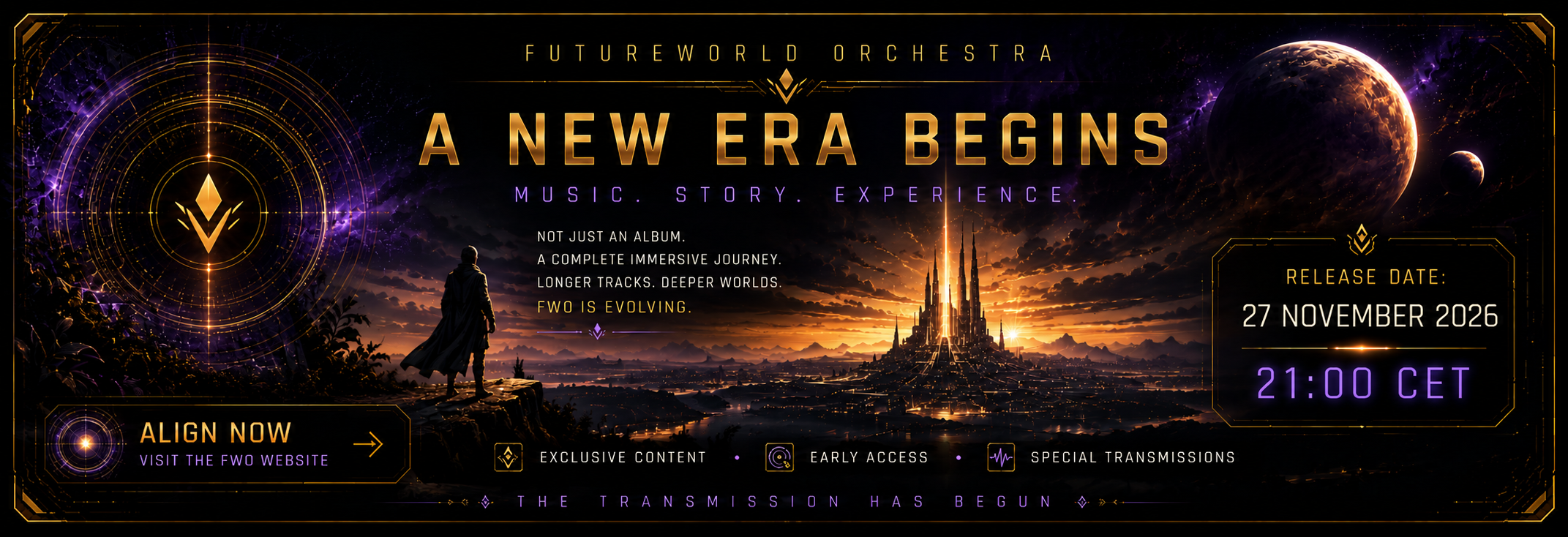
Futureworld Orchestra and emotional worldbuilding
For Futureworld Orchestra, music has never been separated from atmosphere, imagination and emotional storytelling.
The goal is not simply to produce tracks.
The goal is to create immersive emotional worlds listeners can emotionally inhabit.
Science fiction. Cosmic imagery. Synthesizers. Progressive structures. Human emotion hidden beneath futuristic aesthetics.
These elements work together to create emotional resonance rather than merely technical presentation.
The future of human music
Artificial intelligence will undoubtedly continue transforming music creation.
But the deeper emotional role of music may remain profoundly human for a very long time.
Because people do not only listen for sound.
They listen for meaning. Memory. Atmosphere. Connection.
They listen for traces of themselves inside the music.
Stay connected with Futureworld Orchestra and receive future transmissions, previews and special updates.
Align with FWO