When Machines learn to Dream
The Future of Music & Human Creativity
The Democratization of Creation
When I started making music, creating an album was not something you simply “decided” to do. It required instruments, studio time, technical knowledge, money, patience and often years of stubborn dedication.
In those days, access itself was a barrier. You could have ideas. You could hear complete worlds in your head. But turning those ideas into music was something else entirely. Today, I find myself standing in a very different reality.
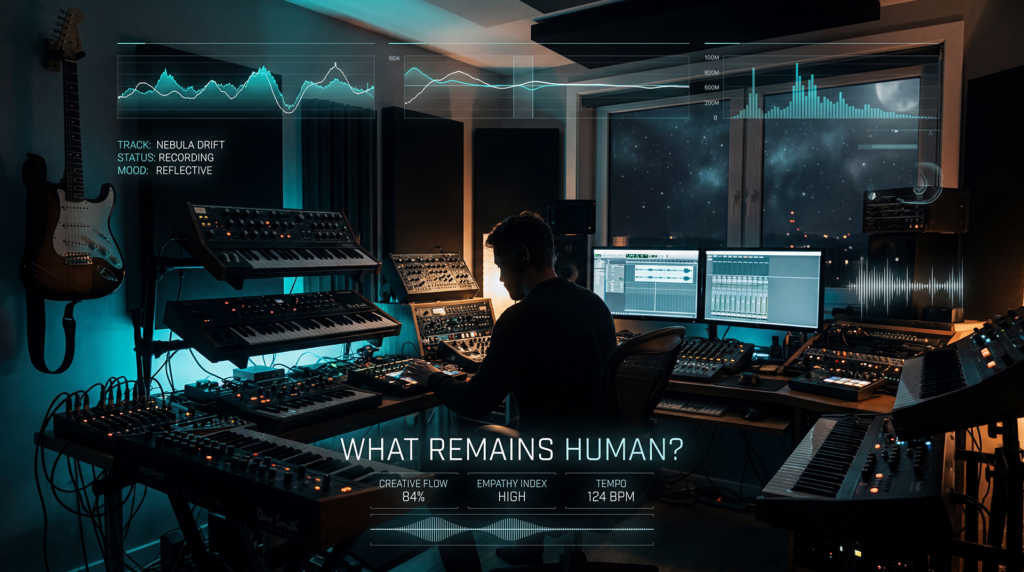
With AI, almost anyone can begin creating music, images, videos and entire worlds from a single room. What once required a studio, a team or a serious budget can now begin with imagination, curiosity and a few carefully chosen words. Part of me finds that beautiful.
FWO has always lived close to technology. Synthesizers, sequencers, digital recording, websites, visual worlds — every era has brought new tools, and every tool changed what became possible.
AI now opens another door. But this door is different. Because when creation becomes available to everyone, instantly and endlessly, a deeper question appears:
If everyone can create, what gives a creation meaning? For me, the answer cannot be found in the machine alone.
It lies in the reason behind the work.
The memory behind the melody.
The human story behind the sound.
Perhaps the future of music will not be defined by who can generate the most. Perhaps it will be defined by who still has something real to say.
Infinite Music
For most of my life, music felt finite.
Albums took years to create. Songs were shaped slowly, often through trial, frustration, discovery and sometimes sheer obsession. Even listening to music itself required intention. You bought a record, placed it on a turntable or cassette deck and gave it your attention. Music occupied a physical place in life.
Today, we are entering an era where music may become effectively infinite. AI can already generate melodies, harmonies, lyrics, voices and complete productions within seconds. Soon, music may become so abundant that humanity will never be able to consume more than a tiny fraction of what machines can endlessly produce.
As both a musician and the creator behind FWO, I find this both fascinating and unsettling. Because abundance does not automatically create meaning. In fact, I sometimes wonder whether the opposite may happen. When everything becomes available instantly, endlessly and effortlessly, perhaps truly meaningful music becomes harder to recognize. Not because great music disappears, but because silence itself disappears.
And maybe silence was always part of the experience.
The anticipation before hearing a new album. The emotional connection with a song you played a hundred times. The feeling that music had somehow become attached to your own memories and your own life.
Infinite creation may become technologically possible. But human attention, emotion and memory remain finite. And perhaps that is exactly where the real value of music will continue to live.
Creativity vs Generation
One of the questions I keep returning to is this:
Is generating something the same as creating something?
Technically speaking, AI can already generate astonishing results. Music, lyrics, voices, images, films and entire visual worlds can now appear within seconds. Sometimes the results are genuinely impressive. I experience that myself almost daily while working on new FWO concepts and visuals. And yet, something important still feels fundamentally different. Because human creativity does not simply emerge from calculation.
It emerges from memory.
From longing.
From loss.
From experience.
From the strange and deeply personal way human beings connect emotions to sound.
When I write music, the process is rarely linear. Sometimes a melody carries traces of childhood memories. Sometimes a sound connects unconsciously to a period of my life, a person, a dream or even a fear I cannot fully explain myself. Real creativity is often messy. It involves doubt, uncertainty, imperfection and emotional contradiction. Many times, the creator himself does not completely understand why something works emotionally — only that it does.
AI, on the other hand, generates through prediction and association. It analyzes patterns, relationships and probabilities at extraordinary scale and speed.
That is undeniably powerful. But I increasingly wonder whether generation alone can ever fully replace the mysterious human process behind creation itself. Perhaps this is where the true distinction begins to emerge.
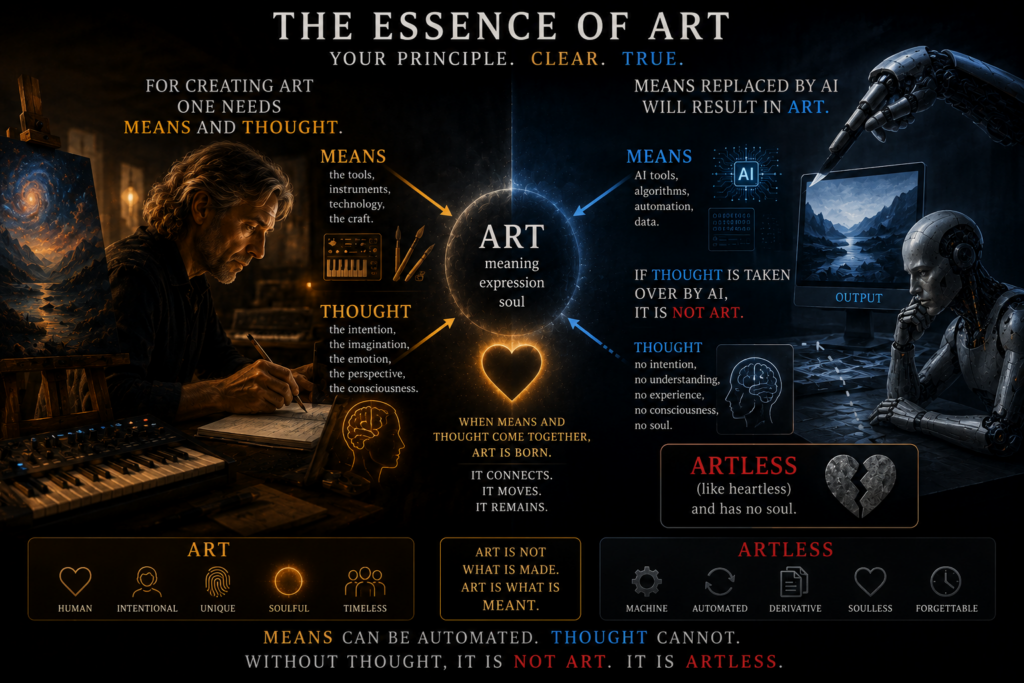
AI may become infinitely capable of generating content. But human beings remain uniquely capable of attaching meaning to it.
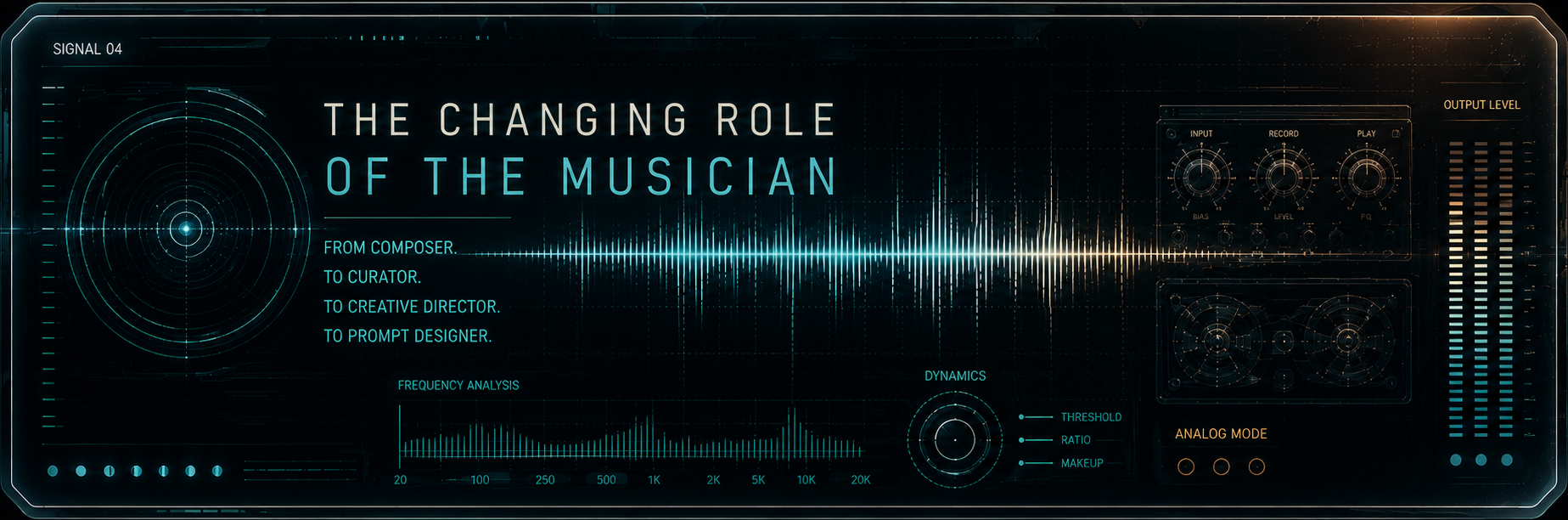
The Changing Role of the Musician
For decades, the role of a musician seemed relatively clear.
You learned an instrument.
You developed technical skills.
You wrote, rehearsed, recorded and performed.
The process itself often demanded years of discipline and persistence before an idea could fully come to life. AI is beginning to change that landscape dramatically.
Today, a single individual can increasingly direct entire creative processes that once required large teams. Music, visuals, films, voices, artwork and even complete fictional worlds can now emerge from one creator working closely with intelligent systems. I experience this transformation myself while building new FWO concepts and visual environments.
Sometimes it genuinely feels as if the role of the artist is shifting. Not disappearing — but evolving. The modern creator may increasingly become:
a director of ideas
a curator of emotion
a guide for intelligent tools
a designer of experiences
a navigator between imagination and generation
And honestly, I do not believe this evolution is entirely negative.
Throughout history, technology has always reshaped music. Synthesizers once frightened traditional musicians. Digital recording changed entire studios. Sampling redefined composition. The internet transformed distribution forever. AI may simply become the next major transformation in that long chain of evolution. But this shift also creates difficult questions. If technical execution becomes increasingly automated, where does the value of musicianship itself eventually reside?
Will future artists still spend years mastering instruments?
Will audiences continue valuing human performance?
Or will emotional vision become more important than technical ability?
I do not yet know the answer. But I suspect the future musician may become something broader than we traditionally imagined. Not merely someone who plays music. But someone who gives meaning, direction and emotional identity to an increasingly intelligent creative universe.
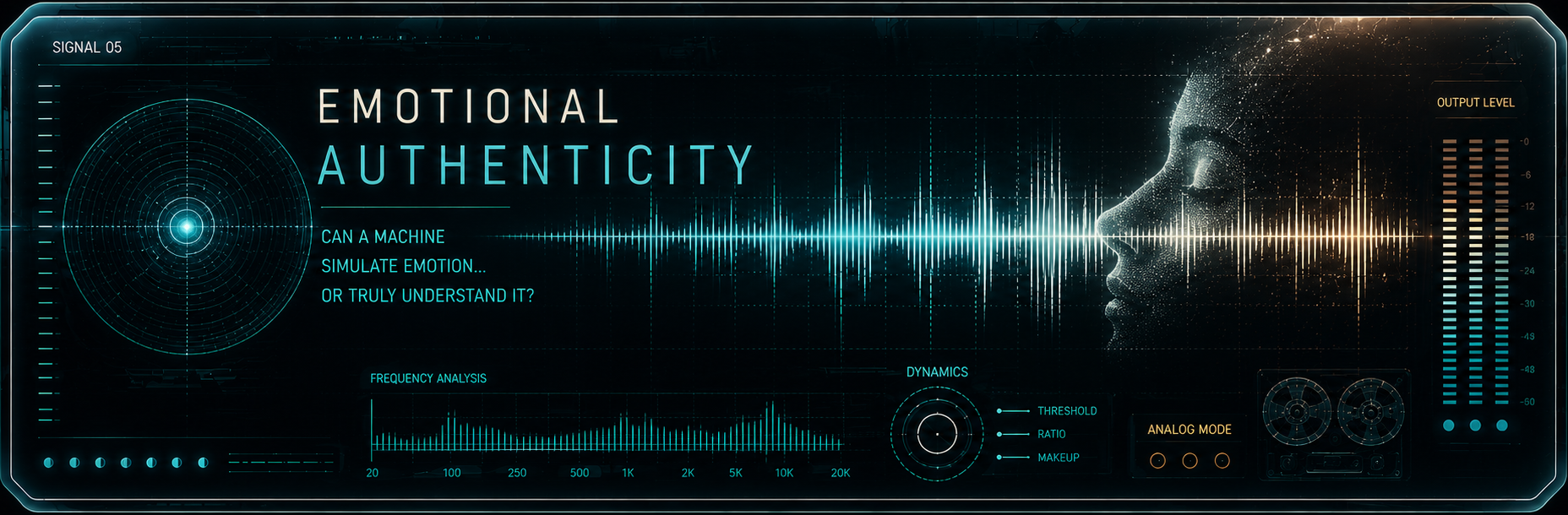
Emotional Authenticity
Perhaps the most fascinating question of all is whether a machine can ever truly understand emotion.
AI can already imitate emotional expression remarkably well. It can generate melancholic melodies, dramatic harmonies, intimate voices and even lyrics that appear emotionally convincing at first glance.
And honestly, sometimes the results are surprisingly moving.
I experience that myself while experimenting with AI inside the evolving world of FWO.
But the more I explore it, the more I feel there is an important distinction between simulating emotion and actually experiencing it.
Because human emotion does not emerge from data alone.
It emerges from living.
From love.
From disappointment.
From memories attached to certain sounds.
From longing for people, moments or dreams that may never return.
When a human being creates music, those invisible experiences often become embedded inside the work itself, even unconsciously. Sometimes a melody carries emotional weight the creator himself cannot fully explain.
That mystery may be one of the most human aspects of art.
AI can analyze emotional patterns at extraordinary scale. It can learn what sadness sounds like. It can imitate tension, beauty, nostalgia or intimacy with increasing precision.
But does it actually feel any of those things?
I honestly do not know.
And perhaps that uncertainty itself is important.
Because maybe the emotional power of music has never only been about what we hear.
Maybe it also comes from knowing that another human being once stood behind the sound, trying to express something real about being alive.
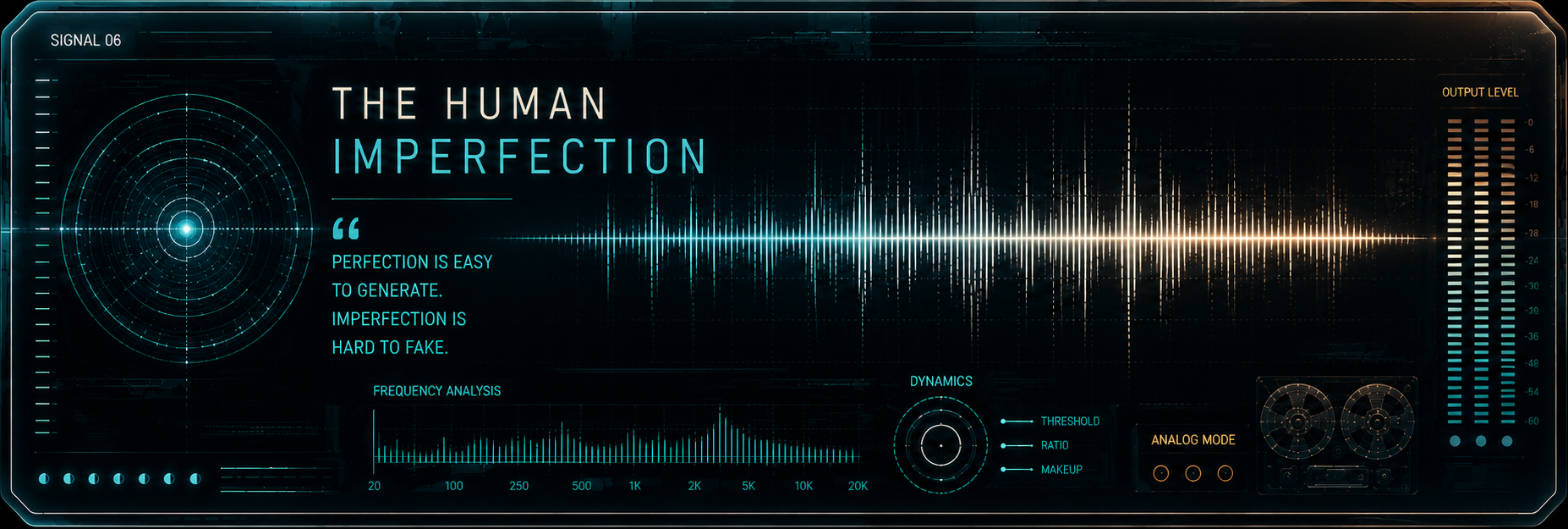
The Human Imperfection
For a very long time, music production moved toward perfection.
Better microphones.
Cleaner recordings.
Perfect timing.
Perfect pitch.
Perfect editing.
Technology continuously pushed music closer toward technical flawlessness.
And yet, many of the recordings people love most are filled with imperfections.
A voice that slightly breaks.
A performance that rushes or drags ever so subtly.
The sound of fingers touching strings.
A breath before a vocal line.
Tiny irregularities that no machine would intentionally design.
Strangely enough, those imperfections are often exactly what make something feel human.
As I continue exploring AI within the creative process of FWO, I increasingly find myself thinking about this paradox.
Because AI naturally moves toward optimization. Toward prediction. Toward technically ideal outcomes.
But human beings rarely connect emotionally to perfection alone.
We connect to vulnerability.
Some of the most powerful music moments in history were never technically perfect. What made them unforgettable was the sense that a real person was present inside the performance — with all the uncertainty, emotion and fragility that comes with being human.
Perhaps imperfections are not flaws at all.
Perhaps they are emotional fingerprints.
And maybe, in a future increasingly shaped by artificial generation, those fingerprints may become more valuable than ever.
Not because humanity is more efficient than machines.
But because humanity remains imperfect in ways machines still cannot truly replicate.
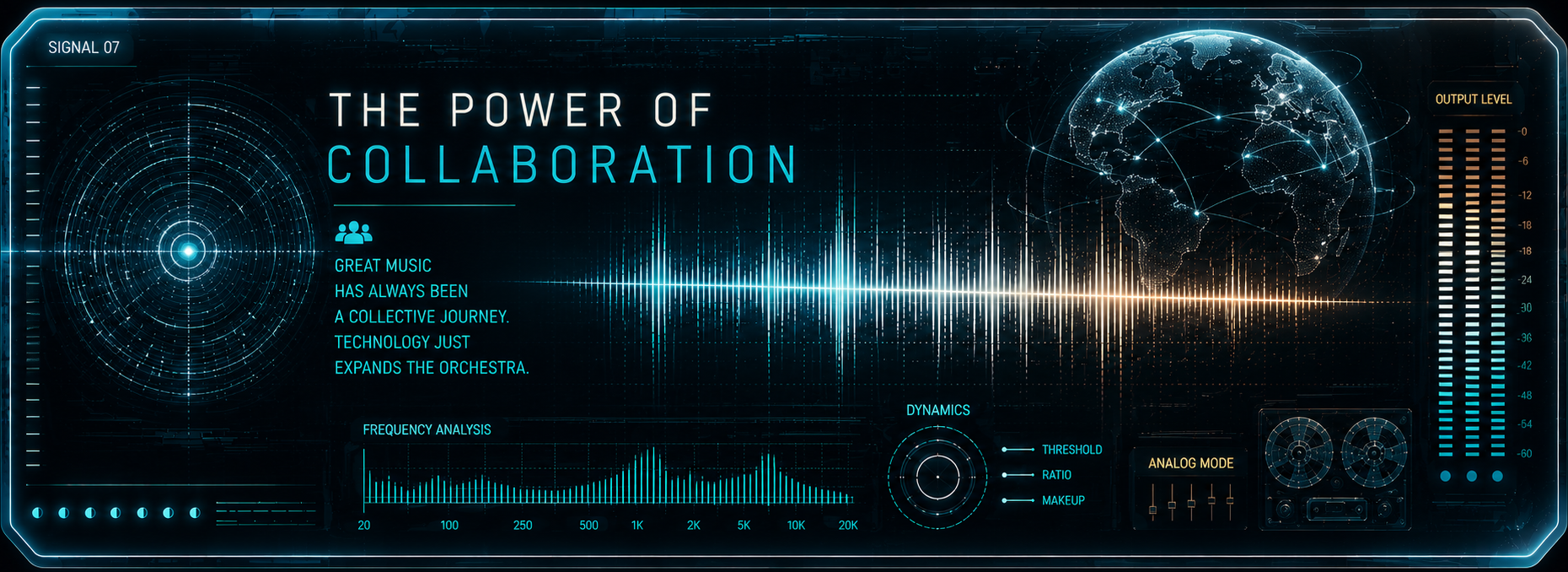
The Power of Collaboration
One of the most beautiful aspects of music has always been collaboration.
Ideas colliding.
Personalities interacting.
Musicians inspiring each other in ways that no single individual could fully predict beforehand.
Some of the most powerful creative moments happen precisely because another human being introduces something unexpected — a feeling, a mistake, a perspective or an emotional interpretation that completely changes the direction of the work.
Real collaboration is rarely efficient.
And perhaps that is exactly why it is so valuable.
Throughout the history of FWO, collaboration has often brought new energy into the creative process. Sometimes another person hears possibilities you no longer hear yourself. Sometimes creativity emerges from conversation rather than control.
AI now introduces an entirely new form of collaboration.
For the first time, creators can interact creatively with intelligent systems that respond, generate, reinterpret and expand ideas almost instantly. In many ways, AI already behaves less like a traditional tool and more like a creative companion participating in the process itself.
I experience this increasingly while developing new music, visuals and concepts.
And honestly, there are moments where the interaction feels genuinely inspiring.
But at the same time, I believe there remains an important difference between collaboration with intelligence and collaboration with humanity.
Because human collaboration carries emotion, unpredictability and shared experience in ways that extend far beyond output alone.
A machine may help generate possibilities.
But another human being can challenge you emotionally. Surprise you philosophically. Inspire you personally. Change not only the work itself, but sometimes even the person creating it.
Perhaps the future of creativity will not revolve around humans versus AI at all.
Perhaps the real challenge is learning how technology can expand human collaboration… without slowly replacing the deeply human connections that made art meaningful in the first place.
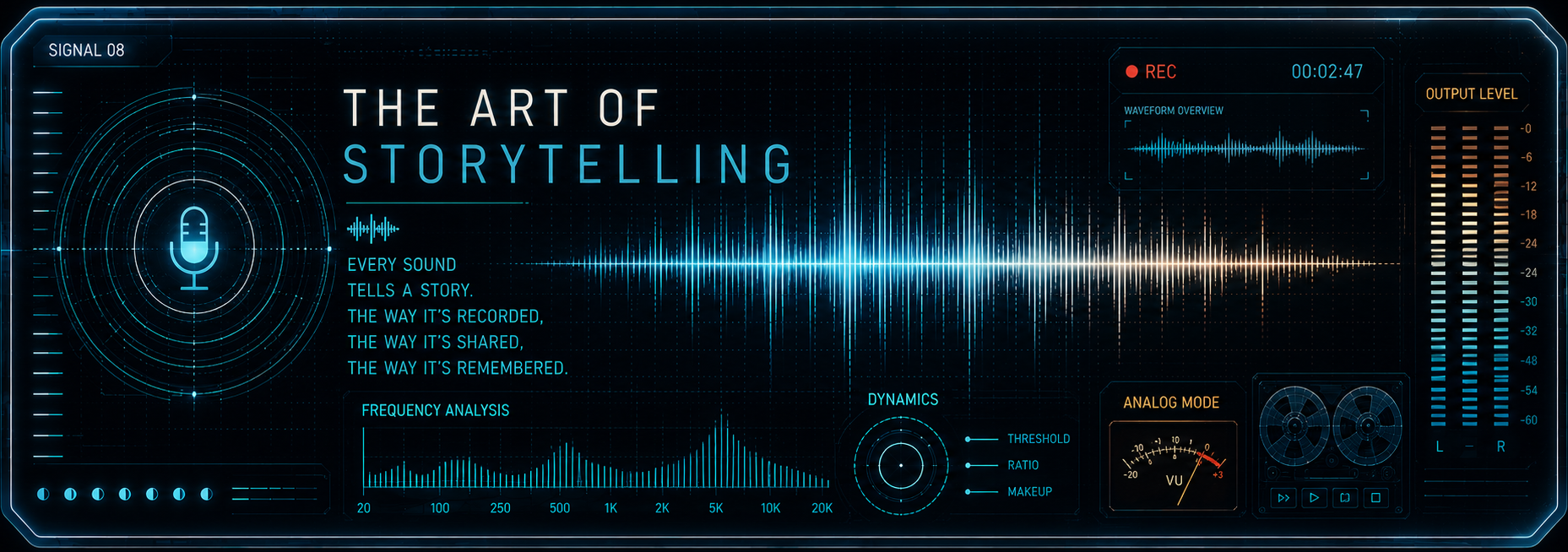
The Art of Storytelling
Long before technology existed, human beings were already telling stories.
Around fires.
Through music.
Through paintings, poems and theatre.
Stories helped humanity preserve memory, meaning and emotion across generations.
And in many ways, music has always been one of the purest forms of storytelling.
Not necessarily through literal words, but through atmosphere, emotion and imagination. A melody can carry longing. A harmony can suggest hope, loss, mystery or wonder without explaining any of it directly.
Throughout the evolution of FWO, storytelling has increasingly become central to the creative process. Not only individual songs, but entire worlds, emotions and experiences began forming around the music itself.
Projects like INT emerged from that same instinct:
the desire to create something larger than isolated tracks alone — something immersive, emotional and alive.
AI now introduces extraordinary new possibilities for storytelling.
A single creator can suddenly generate visuals, environments, voices, cinematic concepts and entire fictional universes at a scale that was previously unimaginable for independent artists.
And honestly, that fascinates me deeply.
But storytelling is not simply world-building.
The true power of storytelling has never only been visual complexity or technical sophistication.
It lies in emotional connection.
A story matters when human beings recognize themselves somewhere inside it.
Perhaps that is why certain stories survive for centuries while countless others disappear almost instantly.
Because meaningful storytelling does not merely present information.
It creates resonance.
AI may eventually become capable of generating infinite narratives, infinite images and infinite experiences.
But the real question may not be whether machines can tell stories.
The real question may be whether they can truly understand why human beings need stories in the first place.
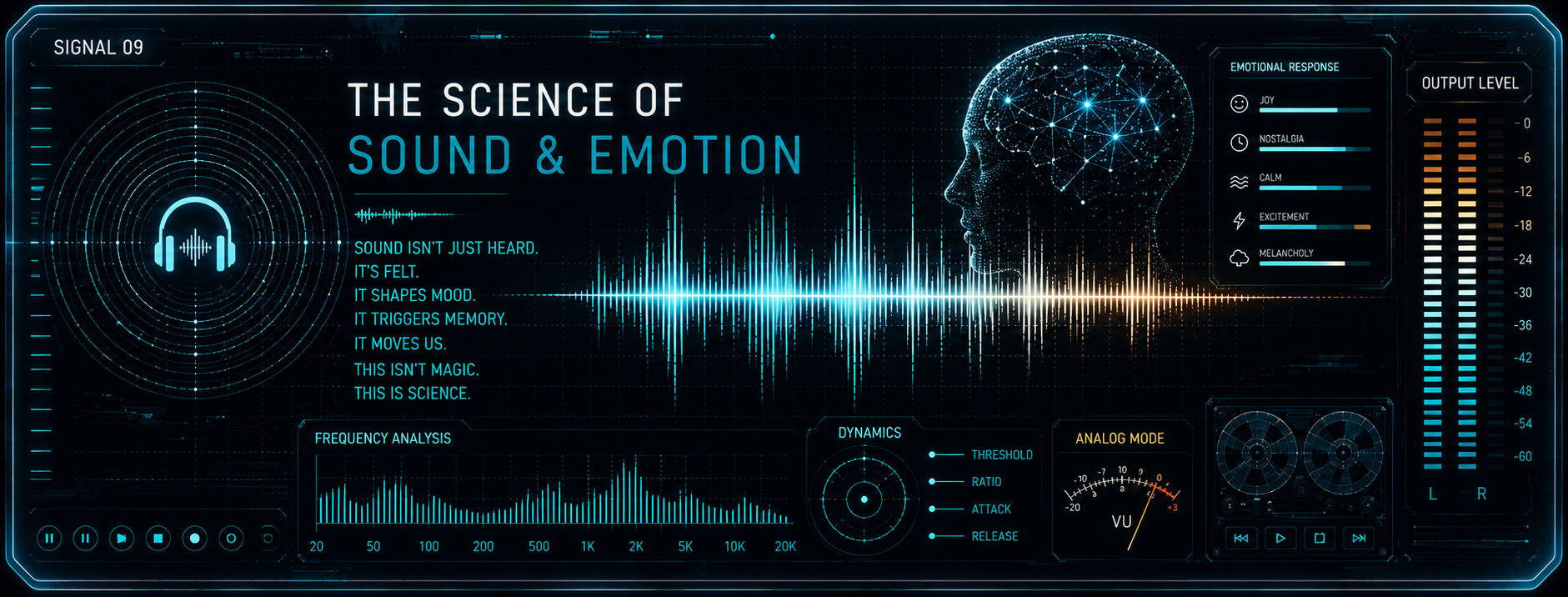
The Science of Sound & Emotion
Music has always existed somewhere between science and mystery.
On one side, sound can be measured with remarkable precision:
frequency,
rhythm,
harmonics,
waveforms,
acoustics,
signal flow.
Technology has allowed us to analyze music in increasingly scientific ways for decades. Studios became more advanced, recordings became cleaner and production tools became astonishingly precise.
And now AI pushes that analysis even further.
For the first time in history, machines can study enormous amounts of music simultaneously — identifying patterns, emotional structures, harmonic tendencies and listener preferences at a scale no human mind could ever fully process alone.
That is both extraordinary and slightly unsettling.
Because emotion itself is now increasingly being approached analytically.
AI attempts to understand:
what sadness sounds like
what creates tension
which harmonies evoke nostalgia
which structures keep people emotionally engaged
In many ways, music is becoming data.
And yet, despite all this scientific understanding, I still believe something essential remains mysterious.
Because human emotional response is rarely completely logical.
Sometimes a simple melody affects us more deeply than an incredibly complex composition. Sometimes a single imperfect note can carry more emotional truth than technical perfection ever could.
As I continue exploring AI-assisted creativity within FWO, I often find myself wondering where the boundary truly lies between measurable structure and emotional experience.
Science can explain how sound behaves.
But can it fully explain why certain music suddenly becomes attached to our memories, our relationships and even our identity?
Perhaps emotion itself will always remain partly beyond calculation.
And perhaps that mystery is not a weakness of music…
but its greatest strength.
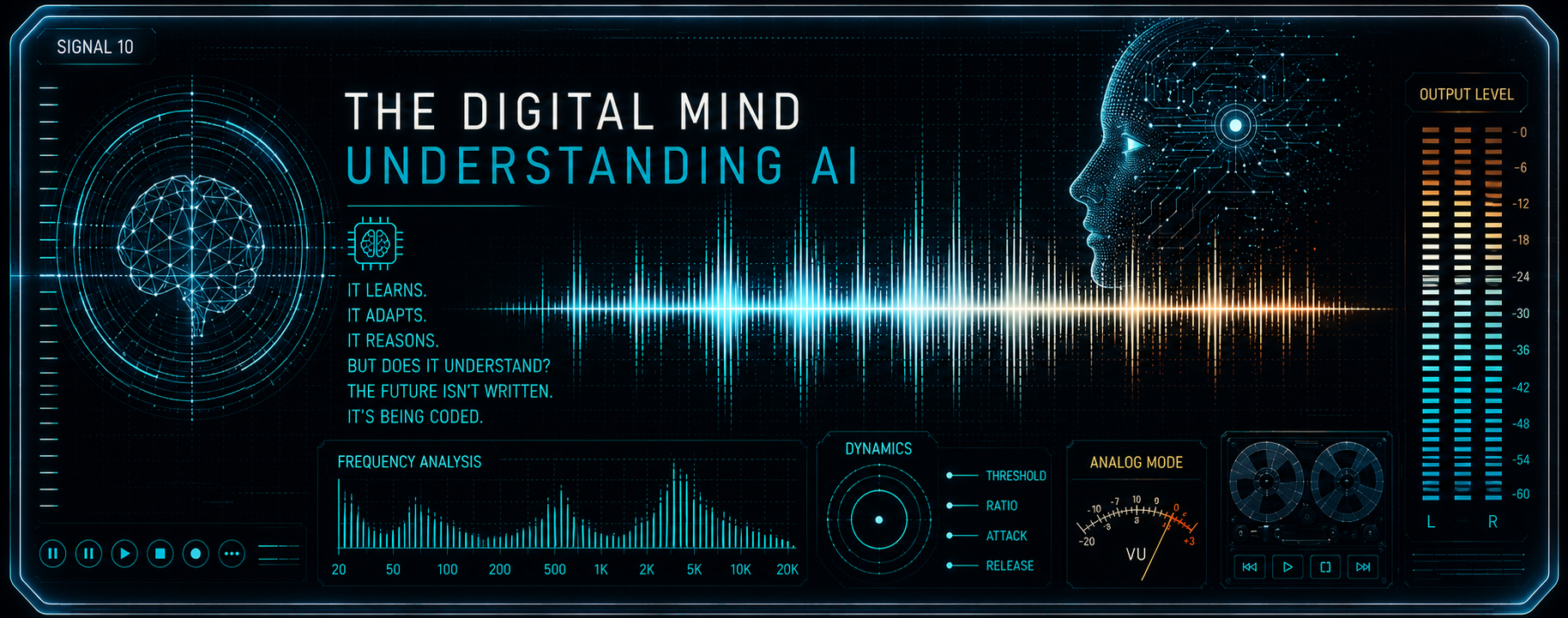
The Digital Mind — Understanding AI
For many people, AI still feels mysterious.
Almost abstract.
We hear terms like:
machine learning
neural networks
generative models
artificial intelligence
And yet, most of us rarely stop to think about what these systems are actually doing beneath the surface.
As I began exploring AI more deeply within the creative world surrounding FWO, I realized something important:
AI does not think like a human being.
At least not in the way we traditionally understand thinking.
A human mind is shaped by:
memory,
emotion,
fear,
desire,
experience,
intuition,
and personal history.
AI, on the other hand, operates through analysis, relationships and prediction.
It studies enormous amounts of information and gradually learns patterns hidden inside that data. In music, this means AI can begin recognizing:
harmonic structures
rhythmic tendencies
emotional patterns
stylistic similarities
production techniques
At extraordinary scale and speed.
In many ways, AI becomes a kind of vast pattern-recognition system.
And honestly, the results can sometimes feel astonishingly intelligent.
But I believe it is important to understand that AI does not experience meaning the way humans do.
It does not sit alone at night listening to music while remembering a lost relationship.
It does not dream about the future.
It does not fear mortality.
It does not experience wonder while watching the moon or hearing a melody for the first time.
It processes relationships between information.
That distinction matters.
Because the more advanced AI becomes, the easier it may become to confuse convincing simulation with genuine understanding.
As creators and listeners, we may increasingly need to ask ourselves not only what AI can generate…
but also what it actually understands.
And perhaps the future of human creativity will partly depend on remembering the difference.
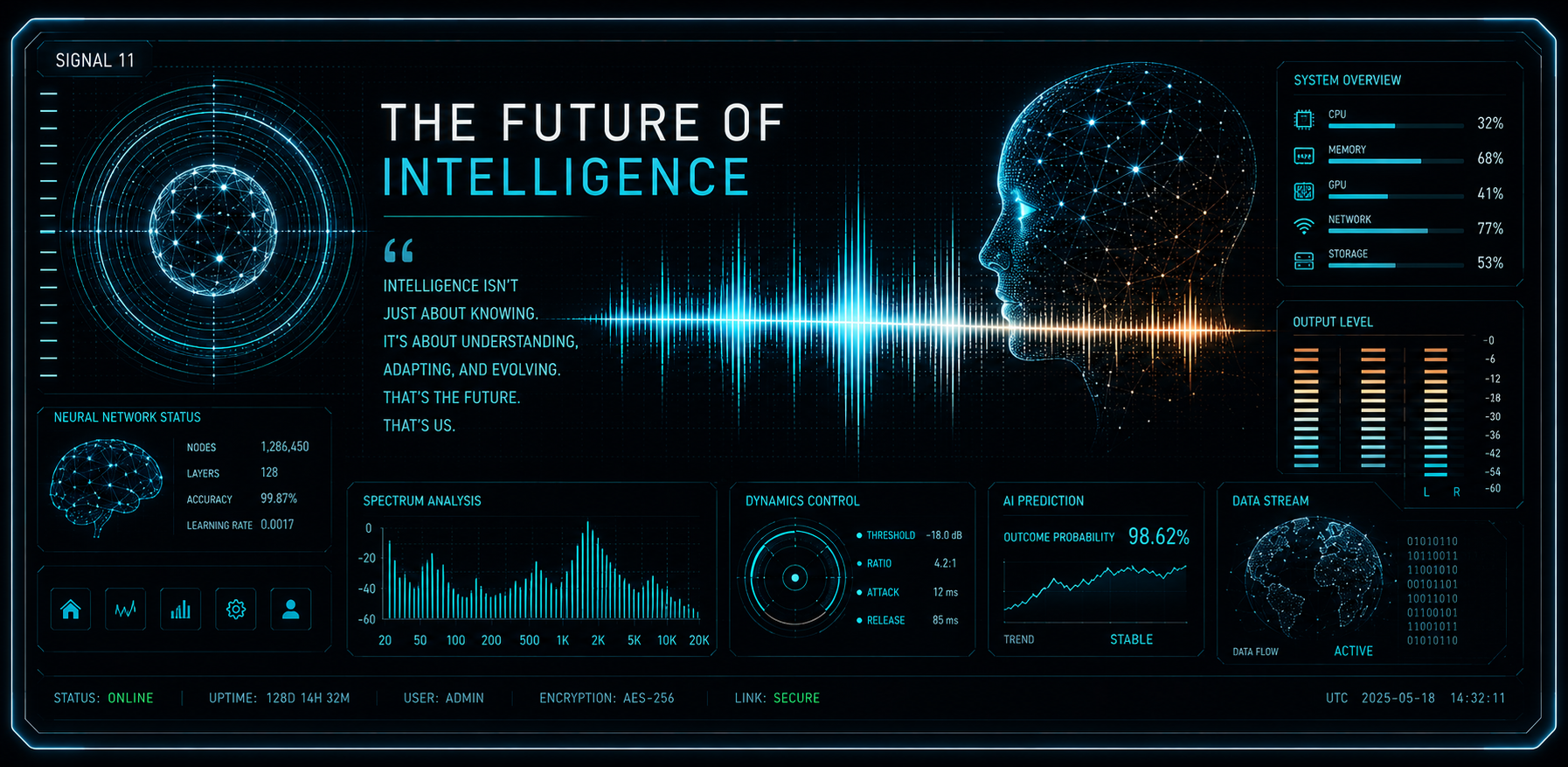
The Future of Intelligence
For most of human history, intelligence was something we associated almost exclusively with living beings.
Human minds.
Human imagination.
Human consciousness.
Now, for the first time, humanity is beginning to create systems that appear capable of participating in activities once considered uniquely human:
learning,
reasoning,
creating,
communicating,
composing,
and increasingly even collaborating.
That realization alone may become one of the most important turning points in modern civilization.
As I explore AI within the evolving creative universe of FWO, I often find myself wondering not only where this technology is going… but where humanity itself is going alongside it.
Because intelligence is no longer developing only biologically.
It is becoming technological.
And that changes the conversation entirely.
For decades, computers mainly extended human calculation and productivity. AI now begins extending something much deeper:
our creative and cognitive capabilities themselves.
That is both exciting and unsettling.
Exciting because AI may help humanity solve problems, accelerate creativity and unlock entirely new forms of expression.
Unsettling because we still understand surprisingly little about intelligence itself — including our own.
What exactly is consciousness?
What creates imagination?
Can intelligence exist without emotion?
Without mortality?
Without human experience?
I honestly do not know.
And perhaps humanity is moving faster technologically than it is philosophically prepared for.
Because the future challenge may not simply be building more intelligent systems.
The greater challenge may be deciding what role human beings still wish to play in a world increasingly shaped by artificial intelligence.
Perhaps the future will not be defined by humans versus machines at all.
Perhaps it will be defined by whether intelligence itself continues to evolve alongside wisdom, empathy and human responsibility.
And that may ultimately become one of the most important creative and societal questions of our time.
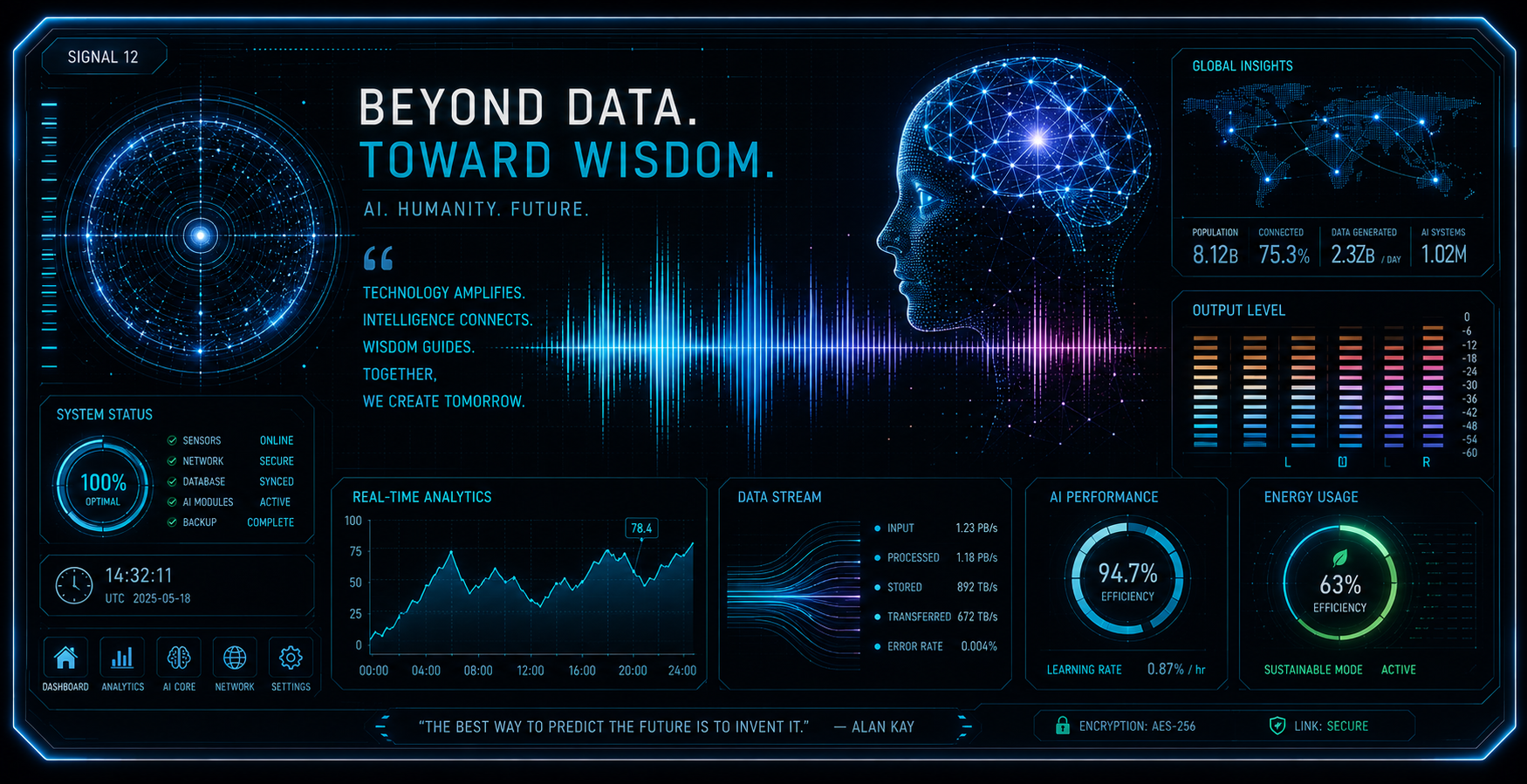
Beyond Data — Toward Wisdom
One of the most extraordinary aspects of AI is its ability to process unimaginable amounts of information.
Data flows endlessly through modern systems:
music,
images,
language,
behavior,
preferences,
patterns,
statistics.
AI can analyze and connect these structures at a speed and scale far beyond human capability.
In many ways, humanity is entering an era where information itself may become almost limitless.
And yet, I increasingly find myself asking a very different question:
Does more information automatically create more understanding?
As I continue exploring AI within the creative world surrounding FWO, I often sense an important distinction between knowledge and wisdom.
Knowledge accumulates.
Wisdom reflects.
Knowledge processes information.
Wisdom understands meaning, consequence and human context.
A machine may eventually learn how to generate astonishingly convincing music, images and conversations. It may predict patterns, optimize systems and simulate emotional responses with incredible precision.
But wisdom is something deeper.
Wisdom requires judgment.
Self-awareness.
Humility.
Empathy.
An understanding of human fragility and consequence.
And perhaps most importantly:
Wisdom requires the ability to ask not only what can be done… but what should be done.
Technology throughout history has often advanced faster than humanity’s ability to fully understand its long-term consequences. AI may become one of the clearest examples of that tension.
Because humanity is no longer merely creating tools.
We are creating systems that increasingly participate in decision-making, creativity and culture itself.
That responsibility should not be taken lightly.
Perhaps the future challenge is not simply building more intelligent machines.
Perhaps the greater challenge is ensuring that human wisdom continues evolving alongside human technological power.
Otherwise, we may eventually become surrounded by infinite information… while understanding less and less about ourselves.
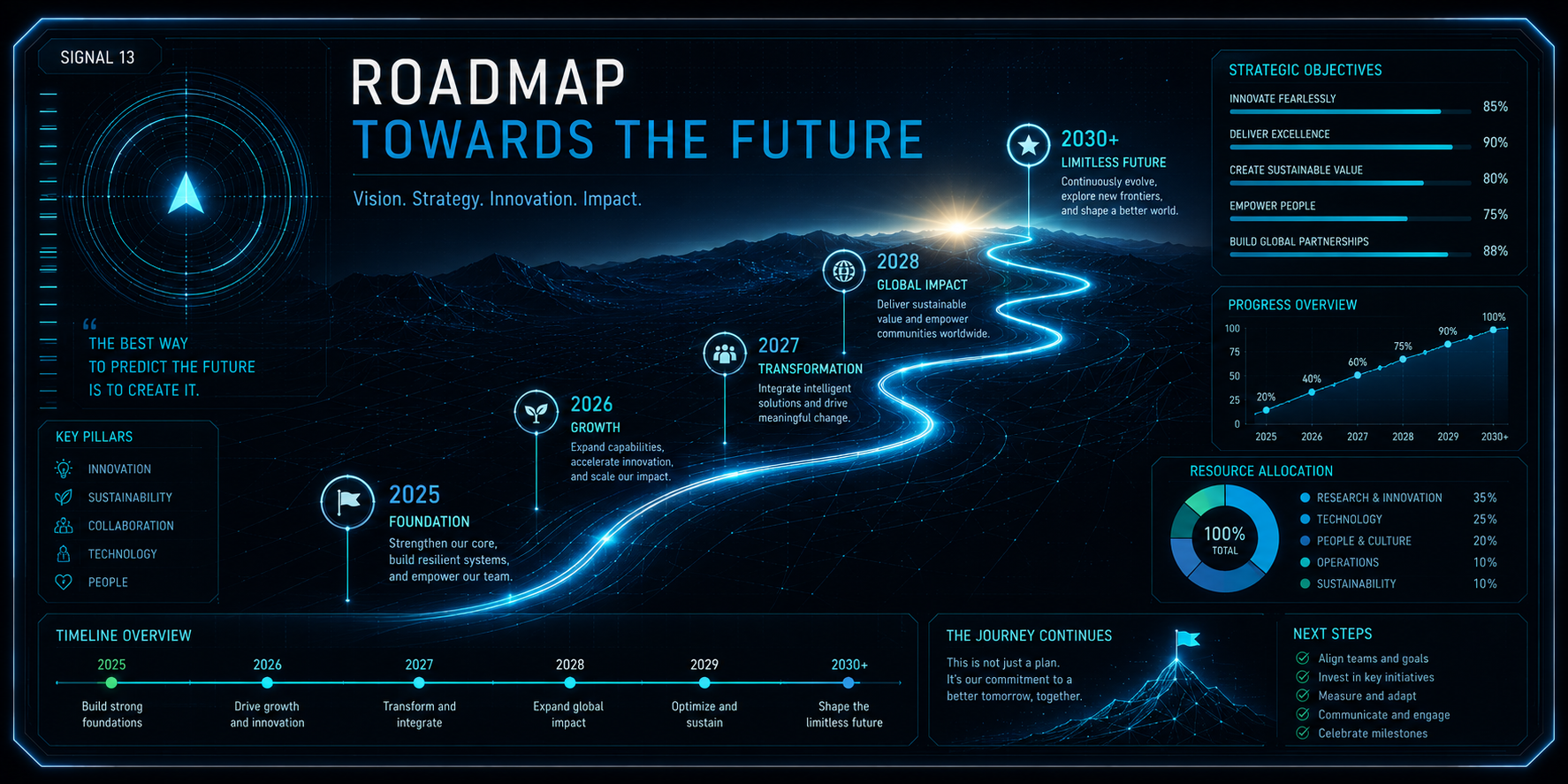
Roadmap Toward the Future
I do not believe the future belongs to people who reject technology.
But I also do not believe it belongs to people who blindly surrender themselves to it.
As I continue exploring AI within the evolving world of FWO, I increasingly see it as something very specific:
Almost like having a group of highly specialized experts permanently gathered around me.
- A composer.
- A visual designer.
- A programmer.
- A researcher.
- A filmmaker.
- A technical assistant.
- A creative sparring partner.*
—– Always available.
—– Always informed.
—– Always operating near the limits of their abilities.
And perhaps most surprisingly of all: Often genuinely inspiring.
AI has already changed the way I think about creativity itself. Not because it replaces imagination, but because it accelerates experimentation. Ideas that once remained trapped in my head for months can now be explored visually, musically and conceptually within hours.
For artists — both professional and amateur — this creates extraordinary new possibilities.
But I believe the future will reward creators who understand one very important principle:
AI is most powerful when it amplifies human vision rather than replaces it.
Technology alone is not enough.
A machine may generate endless possibilities, but it still requires:
- taste,
- direction,
- emotion,
- curiosity,
- identity,
and meaningful human intention.
That remains the responsibility of the creator.
My advice to artists entering this new era would therefore be:
- Stay curious.
- Stay adaptable.
- Experiment fearlessly.
- Learn continuously.
- But never lose sight of your own human perspective.
Do not become intimidated by AI. Learn how to collaborate with it.
Because the artists who may thrive most in the future will not necessarily be those who resist technology entirely, nor those who depend on it blindly.
It may be those who learn how to combine human imagination with intelligent systems in thoughtful and emotionally authentic ways.
And perhaps most importantly:
- Do not underestimate the value of your own experiences, memories and emotional truth.
- This may ultimately become far more difficult to replicate than technical skill alone.
- The future of creativity may not belong solely to humans or machines.
It may belong to those who learn how to build meaningful bridges between both worlds.