
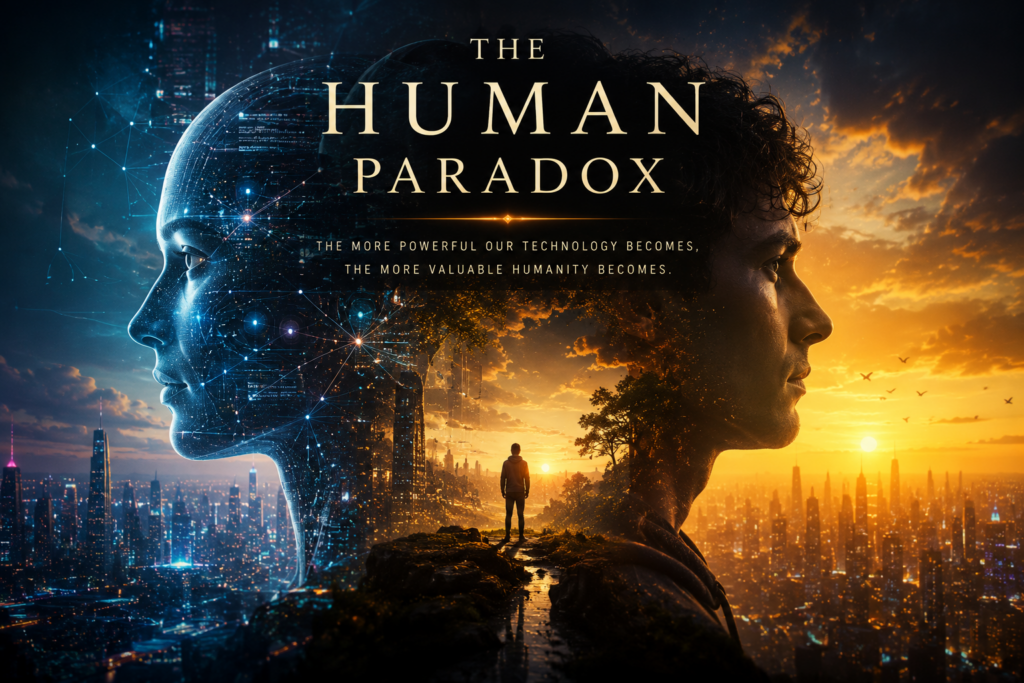
The Human Paradox
The more powerful our technology becomes, the more valuable humanity becomes.
We live in extraordinary times. For the first time in human history, machines can create. They can write, compose, generate images, produce videos and even simulate entire worlds within seconds. Tasks that once required weeks or months can now be completed in moments. The technology is remarkable, perhaps even beautiful. Yet the more I observe this transformation, the more I find myself returning to one unexpected thought: what if the future does not make humanity less important? What if it makes humanity more important?
What if it makes humanity more important?
The Great Acceleration
Throughout history, humanity has built tools to extend its abilities. From the wheel and the printing press to electricity, computers and now artificial intelligence, each innovation has expanded what we are capable of achieving. AI is simply the latest chapter in that story. It allows us to explore ideas faster, create more efficiently and transform imagination into reality with unprecedented speed. In many ways, it represents one of humanity's greatest achievements.
But every major technological leap changes the landscape around it. When something becomes abundant, something else becomes scarce. As the ability to create becomes universal, creation itself becomes less remarkable. The question is no longer whether something can be made. The question becomes why it exists and why anyone should care.
meaning becomes the rarest resource of all.
The Search For Meaning
The internet already contains more information than any previous generation could have imagined. Millions of songs, billions of images, endless videos and virtually unlimited content are available at our fingertips. Yet despite this abundance, people continue searching for something deeper. They search for stories, perspectives, experiences and authentic voices. Human beings are not simply consumers of content. We are seekers of meaning.
This is where something fascinating begins to happen. As synthetic content becomes easier to generate, authenticity becomes more valuable. As information becomes limitless, attention becomes precious. As technology becomes increasingly powerful, people become more interested in the human being behind the creation.
The Things Technology Cannot Experience
Artificial intelligence can write about love, but it cannot fall in love. It can describe loss, but it cannot grieve. It can generate stories about hope, but it has never depended upon hope to overcome adversity. It can create a beautiful image of a sunset, but it cannot stand beneath the evening sky and genuinely experience wonder.
These experiences remain uniquely human. Not because technology is inadequate, but because technology is fundamentally different. It can help us create. It can amplify imagination. It can accelerate possibilities. But it cannot live the experiences that give those creations meaning.
The Human Paradox
This is the paradox. Humanity has spent centuries building increasingly powerful technologies, yet those same technologies may ultimately remind us what makes us human. Not because technology is failing, but because it is succeeding. The more capable our tools become, the more clearly we begin to recognize the value of imagination, empathy, curiosity, emotion and lived experience.
The qualities we once took for granted suddenly become precious. The future may not ask us to become less human. It may ask us to become more human than ever before.
will be reminding us why humanity matters.
Looking Forward
I do not believe the future belongs only to machines. Nor do I believe it belongs to humans pretending nothing has changed. I believe the future belongs to those who understand how to combine both. People who embrace technology without surrendering their humanity. People who use powerful tools while remaining connected to imagination, emotion and purpose.
Because in the end, the question is not whether machines can create. They can. The real question is whether we can continue to create from somewhere meaningful. Whether we can continue to tell stories that matter, build connections that matter and imagine futures worth believing in.
the more important it becomes to remain human.
That is the Human Paradox. And perhaps it was the destination all along.
The Human Paradox
A lifelong exploration of imagination, humanity, hope and the future.
Stay connected with Futureworld Orchestra and receive future transmissions, previews and special updates.
Align with FWO