
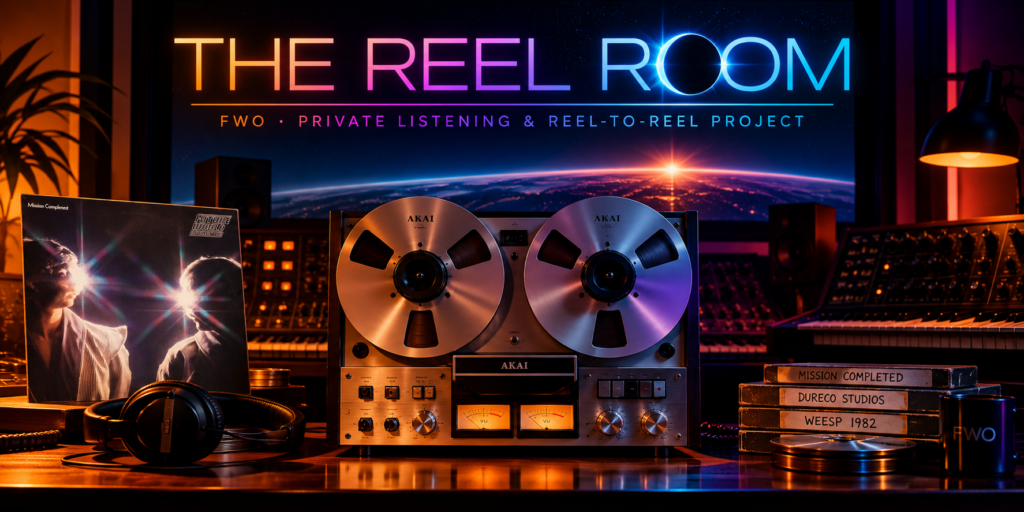
PRIVATE LISTENING ROOM / REEL-TO-REEL PROJECT
A private page for registered listeners only !
Turn it up. Take your time. This is where the journey begins.
- - MISSION COMPLETED - -
INSIDE DURECO STUDIOS
Dureco Studios in Weesp, Holland
This was an entirely different world from today's computer-based recording studios. Music travelled through microphones, analogue electronics and a large-format mixing console before being recorded onto magnetic tape. Tape machines were running, meters were moving, engineers were working behind a large console — and decisions made during a session really mattered.
At the heart of the Dureco control room was the CADAC E-Type, a substantial 40-channel, 32-bus inline console built by Clive Green in 1976. This was the console used during the recording of Mission Completed.
24 TRACKS OF ANALOGUE TAPE
Mission Completed was recorded on a professional 24-track analogue tape machine using 2-inch tape. Instead of seeing tracks as coloured blocks on a computer screen, the individual recordings physically existed next to one another across the width of the magnetic tape.
The exact make and model of the 24-track recorder used for the album has not yet been conclusively documented. One possible candidate is the legendary Studer A800 Mk III 2-inch 24-track recorder, a machine designed for exactly this kind of professional multitrack recording.
The Studer A800 Mk III is currently part of our historical reconstruction of the Dureco recording setup. Until original documentation confirms the machine used for the 1982 sessions, we regard the exact model as possible rather than established fact.
THE STUDER CONNECTION
We do know that Studer tape technology was present in the Dureco environment. A surviving Studer A80-R has been traced back to the former Dureco Studios, where it was reportedly used primarily for editing.
Whether that particular machine — or another Studer recorder — played a part in the final mix or master-tape stage of Mission Completed has not yet been established. That is one of the details of the original recording process we are still trying to reconstruct.
THE SOUND AROUND THE CONSOLE
Dureco was, of course, much more than a mixing desk and a tape recorder. The studio environment included professional microphones, compressors, equalizers, reverberation and effects equipment. Equipment associated with the historic Dureco and later E-Sound environment includes names such as Neumann, Schoeps, Sennheiser, UREI, EMT, Lexicon, Eventide and Orban.
Among the documented equipment are classics such as the
UREI 1176, EMT 140 plate reverb,
Lexicon 224 and Eventide H910,
together with classic Neumann microphones including the
U47, U67 and U87.
(Not every individual piece of this equipment has been confirmed as having been used specifically on Mission Completed.
Where the original session documentation is incomplete, we prefer to keep that distinction clear.)
For us, entering Dureco meant entering the world of professional record making. We had written the music, but here it had to become a record.
There was something wonderfully physical about the whole process. Tape actually moved. Meters moved. Faders moved. You listened — and you made decisions.
More than forty years later, bringing Mission Completed back on real Reel-to-Reel tape therefore feels less like putting the album on a new format — and more like bringing it home.
ROBERT POT - Futureworld OrchestraOctober 2026
MORE THAN A CADAC
The CADAC console and 24-track tape machine were only part of the Dureco recording environment. The studio also contained an extensive collection of professional microphones, compressors, equalizers, reverberation and effects equipment.
Equipment documented as part of the historic Dureco and later E-Sound studio environment includes some of the classic names and machines of professional analogue recording.
DYNAMICS
EQUALIZATION
REVERB & EFFECTS
MICROPHONES
TAPE & EDITING
STUDIO INSTRUMENT
This is equipment documented in connection with the historic
Dureco and later E-Sound studio environment. It should not be
assumed that every item listed here was present in exactly this
configuration in 1982, or that every piece of equipment was used during the recording of
Mission Completed.
Where the original session documentation is incomplete, we prefer to leave the question open rather than turn a possibility into a fact.

YOU'VE SEEN THE CADAC BEFORE
Turning Point, our second album, was also recorded at Dureco Studios in Weesp.
And there is a rather special piece of studio history hidden in plain sight on the album cover. The photograph used in the artwork shows the actual CADAC mixing console at Dureco — the same console that had already been at the heart of the recording of Mission Completed.
So this isn't a photograph of a similar vintage console added decades later for nostalgic effect. It is part of the real FWO story: the desk, the studio and the technology with which our music was made.
More than forty years later, the cover itself has become a small photographic document of the analogue world in which those first Futureworld Orchestra albums were created.
OTHER FWO MEDIA
The Reel-to-Reel project may become one of the rarest ways to own and experience Futureworld Orchestra.
But the music doesn't end here. Mission Completed and other FWO releases are also available on physical media — for those who still believe that music deserves something more tangible than a file or a stream.
Different formats - Different experiences.
The same FWO music.